
Scene Overview
Industry Overview & FSR Value
Precision manufacturing, automated assembly cells, and heavy machinery demand ruggedized tactile sensors that operate reliably under harsh mechanical loads, lubricant exposure, and continuous thermal cycling.
Industry Context & Quality Control Gaps
Industrial automation and precision fabrication rely heavily on verified physical contact and uniform force distribution. Traditional indirect measurement methods often fail to catch localized defects:
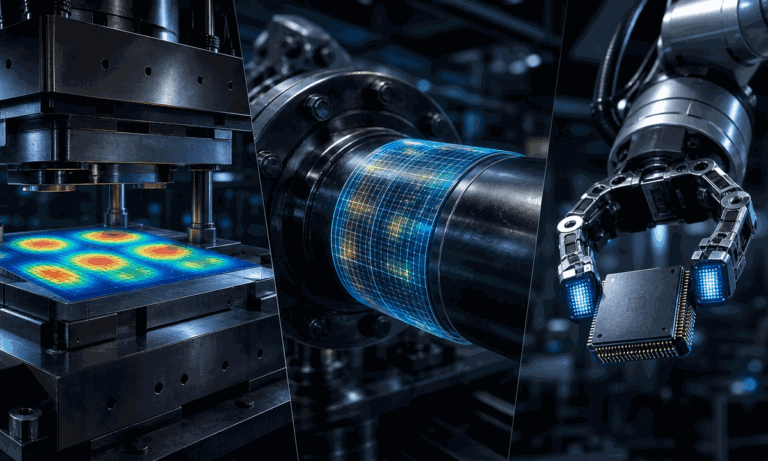
- Invisible Pressure Imbalance: In CNC multi-point clamping, stamping dies, and heat-sealing bars, uneven force distribution causes part deformation, tool wear, and micro-leak defects that torque wrenches cannot detect.
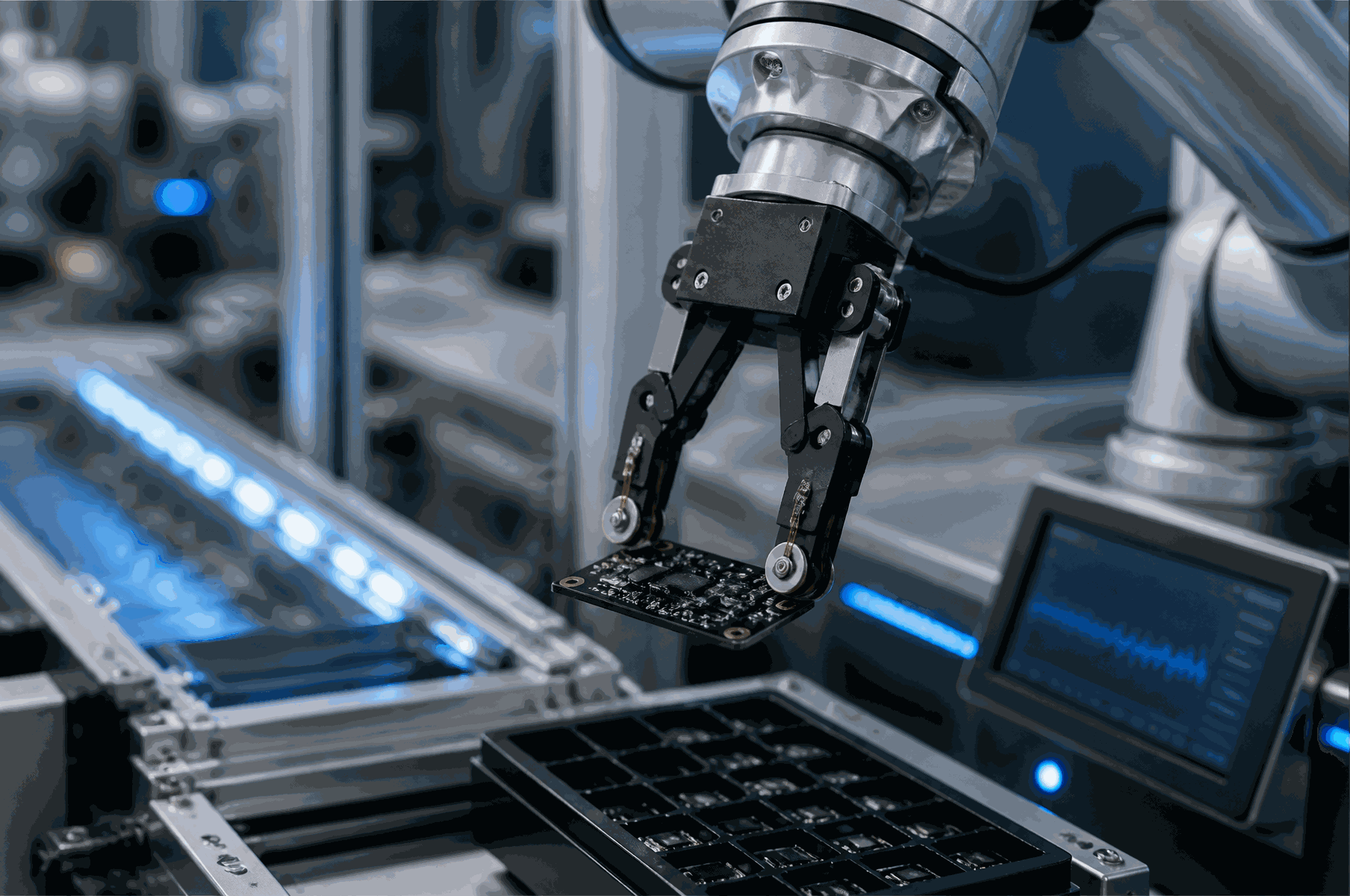
- Fragile Part Handling in Robotics: Standard position-based robot grippers risk crushing delicate PCBs or glass substrates during pick-and-place cycles when component tolerances vary.
- Harsh Factory Environments: Sensors must withstand vibration, cutting fluids, hydraulic oils, and temperatures ranging from -20°C to +85°C without signal degradation.
FSR Value & Engineering Solution
FSRTEK delivers ruggedized tactile verification arrays for inline process monitoring:
- Ultra-Thin Matrix Tactile Mapping: Flexible sensor films (<0.25mm) slide directly into clamp interfaces, stamping dies, or flange gaskets to record high-resolution pressure distribution maps before production cycles begin.
- Closed-Loop Gripper Tactile Feedback: Compact tactile fingertip arrays provide real-time contact detection, grip force regulation, and slip monitoring for collaborative robots and automated assembly cells.
- Industrial Interface Integration: DAQ electronics support standard industrial communication protocols (RS-485, Modbus, Ethernet/IP, CAN bus) with programmable threshold alarms for automated line interlocks.
Industry Environment
Operating Environment & Sensor Integration
Projects In This Scene
Concrete Projects In This Scene
Need a solution for a similar application?
Send us your target force range, sensing area and integration constraints.